skip to main |
skip to sidebar
Welcome to South Seas Cinema, a series of posts about films set in – or pertaining to – Polynesia and the South Pacific.
Okay okay, so it's been months since I posted anything in my SSC series. I blame an ocean of other obligations and, honestly, just not coming across any truly inspiring movies with the right sort of South Seas slant. Anyway, I recently happened upon a set of good ones that has me all fired up to rant about. It's called Eux et Moi, a DVD collection of two short films by French ethnographer, Stéphane Breton, about his experiences in "the field" - a small village in the Highlands of Papua New Guinea.
Eux et Moi is post-modern Anthropology at its most compelling. Breton shares his insights, discoveries and doubts openly in equal measure as a social scientist and storyteller. His rapport with the villagers makes for great viewing, and - without giving too much away - his inadvertent role in shaping the dynamics of the village is fascinating.
Eux et Moi is narrated in English and French with subtitles in both as well. I'm not quite sure how to get ahold of a copy. Unless, like me, you pick one up at the Musee du Quai Branly in Paris. Here's a link to the museum's bookstore; they might be able to help.
---
South Seas Cinema is sponsored by
DESIGNinBLUE
architecture&design
mail@designinblue.com
+44 20 (0) 7947 359 456
+44 20 (0) 7950 674 636
Welcome to South Seas Cinema, a series of posts about films set in – or pertaining to – Polynesia and the South Pacific.
If you like Kon-Tiki then check out The Last Navigator, a 50-minute film directed by Andre Singer in 1989. Set in Micronesia, The Last Navigator documents a 500-plus mile open sea voyage from the Micronesian island of Satawal to Saipan in a traditional outrigger and without the aid of modern navigational equipment.
Among the crew is American navigator Stephen Thomas, who spent nine months learning the navigation traditions of the Satawal islanders. Thomas is taught by Piailug, to whom the film’s title refers. Piailug is considered the most experienced of the Satawal islanders, if not all of Micronesia. Discouraged by the younger islanders’ lack of interest in learning traditional navigation, Piailug reluctantly agrees to teach Thomas, lest his cultural knowledge be forgotten.
I caught the film at the British Museum as part of their Power and Taboo exhibition. From my brief search on the Internet, I've come to the conclusion that it's pretty hard to catch a viewing of this film and that it's not on DVD or at least not readily available to the public. However, I did notice that a paperback written by Stephen Thomas and sharing the same title as the film is for sale on Amazon.
Click here for more info about The Last Navigator.
South Seas Cinema is sponsored by
DESIGNinBLUE
architecture&design
mail@designinblue.com
+44 20 (0) 7947 359 456
+44 20 (0) 7950 674 636
The content of this post originally appeared on this blog November 27, 2006.

Welcome to South Seas Cinema, a series of posts about films set in – or pertaining to – Polynesia and the South Pacific.
Today marks the 60th anniversary of the original Kon-Tiki voyage; thus, choosing the voyage's corresponding documentary as this month's South Seas Cinema review seemed only natural. The film, Kon-Tiki, records the 1947 transpacific voyage of Norwegian scientist, Thor Heyerdahl, and his crew of four Norwegians and a Swede adventures at sea, as they set out to prove the plausibility of a hunch.
While in the Marquesas for a zoological expedition, Heyerdahl noticed that prevailing winds and ocean currents from the Americas appeared to greatly affect the islands’ flora and fauna. From this observation, he began to doubt the general consensus that Polynesians’ ancestors had taken a direct westerly route when colonizing the region. Heyerdahl suggested that, although all Pacific Rim peoples originally had hailed from Southeast Asia, the route from there to Polynesia had followed the prevailing winds and currents from Northwest America.
In 1947, Heyerdahl and his crew of four Norwegians and a Swede set out to prove his theory was plausible by sailing more than 4000 miles from Peru to the Tuamotu Islands aboard a balsawood raft constructed in prehistoric South American style. Heyerdahl dubbed the raft Kon-Tiki, after the legend of a seafaring sun-king that Heyerdahl proposed to be common among ancient Incas and early Polynesians.
So incredible was the Kon-Tiki voyage that many scientists refused to believe that it actually happened. It wasn’t until the 1951 release of the Kon-Tiki documentary about the expedition was released that academics began to take notice – along with the rest of the world. Later that year, Kon-Tiki went on to receive the Oscar for best documentary.
Although, most anthropologists continue to believe, based upon a preponderance of evidence, that Polynesia was settled from west to east, Kon-Tiki proved that Polynesia was within range of prehistoric South Americans and went on to further inform and enhance research pertaining to the settlement of the Pacific Rim. But more than these accomplishments, the expedition captured the imagination of millions.
Perhaps more than anything, Kon-Tiki (along with Heyerdahl et al’s subsequent South Pacific adventures) firmly placed the word “Tiki” into the psyche and vernacular of a generation, inspiring a plethora of products, such as dinnerware, board games and several books. Would Polynesian Pop, as we know it today, even exist if it weren’t for this plucky theorist and his crew of Scandinavian adventurers?
Welcome to the third installment of South Seas Cinema, a series of posts about films set in – or pertaining to – Polynesia and the South Pacific.
Trobriand Cricket: An Ingenious Response to Colonialism (1979)
Trobriand Cricket: An Ingenious Response to Colonialism documents how the British sport of cricket evolved to suit the cultural needs of Trobriand Islanders. In many ways, Trobriand Cricket is your run-of-the-mill academic documentary: monotone narrative, shots more to document than for artistry. Still, the glimpse into colorful Trobriand society makes this documentary well worth seeking out.
The Trobriand Islands lie off the coast of Papua New Guinea. With colonization of the islands in the 1900s came the introduction of cricket. Islanders soon adopted it as their sport of choice, replacing traditional warfare with this considerably more benign game.
Most fascinating is the way the people of the Trobriands adapted the sport to their own way of life. As opposed to standard twelve player teams, Trobriand teams may have as many eligible men from a particular community as possible. Another unique feature to cricket in these islands is the incorporation of magic. Perhaps most different than any sport anywhere else in the world, the home team always wins in Trobriand games.
One amusing similarity with western sports is the inclusion of a mascot on the team. In the film, one team’s mascot is a man dressed up to be a western tourist jumping about and pretending to take photographs at every important moment in the game.
Trobriand Cricket features not a lick of drama, and the cinematography is far from breath-taking. However, the subject matter is captivating. If you took Anthropology 101 at university and really enjoyed it, this film is for you. Of course, finding a copy might not be easy. Ronin Films carries copies on VHS, but they ain’t cheap. If in London, I recommend visiting the British Museum Centre for Anthropology, which has a copy that is free to view at the centre. Otherwise, check with the anthropology department at your local university or with your local public library.

Welcome to the second installment of South Seas Cinema, a new series of posts about films set in – or pertaining to – Polynesia and the South Pacific.
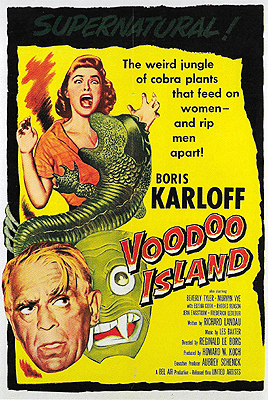
Voodoo Island (1957)If the idea of Boris Karloff with a tan intrigues you, then you're bound to enjoy the camp 1950's horror film, Voodoo Island. More deeply intriguing is why Karloff - already a renown actor with dozens of major films under his belt - chose to be in this B-movie.
Perhaps he wanted a working vacation in Hawaii. Shot entirely on Kauai, Voodoo Island is set on a South Pacific island, where man-eating carnivorous plants and zombies are making things difficult for a wealthy developer bent on creating a luxury resort. How the west African/Caribbean practices of Vodoun made it to this mythical Polynesian island is anyone's guess.
Initially, I fretted that such incongruity would create too unbelievable a story to follow. But, with a theremin-heavy original score by exotica legend Les Baxter, I found it easy to kick back and enjoy Voodoo Island on its own terms; Lots of tiki (toward the end of the film), thatched huts, swinging bridges, tapa cloth, and Kauai's lush beauty helped too.
Voodoo Island is not a great movie, but it is fun to watch. For my part, I was curious to see a zombie movie set in Polynesia (just in time for Zombruary!). My albeit low expectations were exceeded and I have a feeling that a repeat viewing is nigh.
Voodoo Island is available on a two-for-one DVD along with The Four Skulls of Jonathan Drake.
Zombruary 2007 is sponsored by Tiki Racer.
architecture&design
mail@designinblue.com
+44 20 (0) 7947 359 456
+44 20 (0) 7950 674 636
Welcome to South Seas Cinema, a new series of posts about films set in – or pertaining to – Polynesia and the South Pacific.
Tabu, a Story of the South Seas (1931)
For my first review, I’ve chosen one of my absolute favourite films: Tabu, a Story of the South Seas. If you haven’t seen this classic film directed by anthropologist documentary-maker Robert J. Flaherty (Nanook of the North) and German expressionist F.W. Murnau (Nosferatu), then make viewing it a priority. And, if you ever get a chance to see Tabu on the big screen, by all means go!
Shot entirely on location in Bora Bora in the 1920s, Tabu, a Story of the South Seas is one of the most visually compelling films I've had the pleasure to view. In fact, cinematographer Floyd Crosby won an Academy Award for its cinematography. At slightly more than 80 minutes, this poignant black and white, silent film engrossed me and left me longing for more.
Tabu tells the story of two young lovers that are mad about each other, but society just won't let them be. Yes, very Romeo and Juliet ... but set during the late 1920's ... in Tahiti ... with a completely Tahitian cast. All of which makes for some very endearing acting in a movie where everybody's gorgeous and the scenery is breathtaking.
The tragic story still haunts my imagination (I viewed it for the second time over a month ago) - I mean, I’m really not one for love stories, but this one really gets to me. For what it's worth, the film has been deemed "culturally significant" by the United States Library of Congress and selected for preservation in the National Film Registry. Tabu was restored by the UCLA Film and Television Archive and has been released on DVD by Milestone Films.
architecture&design
mail@designinblue.com
+44 20 (0) 7947 359 456
+44 20 (0) 7950 674 636


